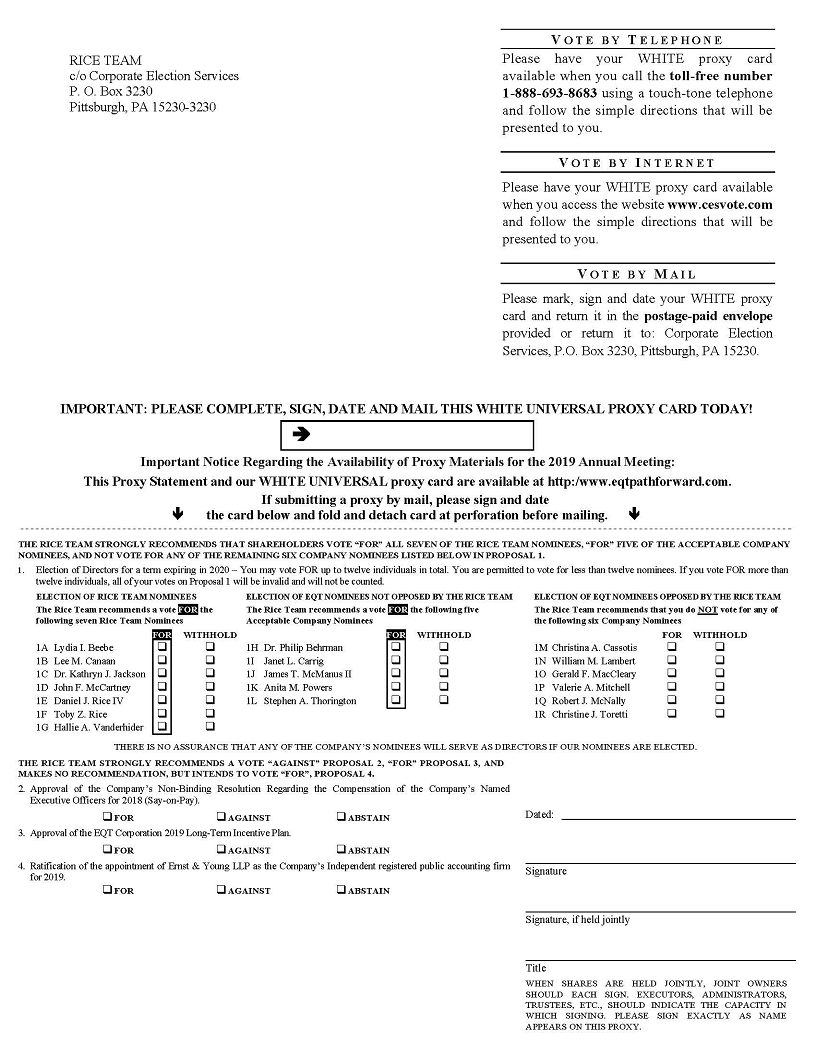
Here’s big news on the universal proxy front: yesterday, at EQT Corporation’s annual meeting, a dissident group won control of the company’s board through a proxy fight waged using a universal proxy card. According to this Olshan memo, this marks the first time that such a card was successfully used in a control proxy contest in the US. Here’s an excerpt:
The universal ballot adopted by both EQT and the Rice Team named both EQT’s and the Rice Team’s nominees on their respective proxy cards. The only difference related to the presentation of the two cards, in which each side highlighted how it desired shareholders to vote. Copies of the two cards can be found here (Rice Team) and here (EQT).
As shown, the Rice Team made clear on its proxy card a recommendation for all seven of its nominees and for five of the Company’s nominees that it did not oppose, to permit shareholders to vote for all 12 available spots. Similarly, the Company recommended a vote for all 12 of its nominees and against the Rice Team’s nominees, other than existing director, Daniel Rice IV, who was nominated by both EQT and the Rice Team.
The Rice Team obtained public support from many of EQT’s largest shareholders, including T. Rowe Price Group Inc., D.E. Shaw & Co., Kensico Capital Management Corp. and Elliott Management Corp., along with proxy advisory firms Institutional Shareholder Services (“ISS”) and Egan-Jones Ratings.
The use of a universal ballot for a majority slate of directors is unprecedented and, in our view, may become more common in future proxy contests given the Rice Team’s success here. In fact, ISS noted the following in its report recommending that shareholders vote for all of the Rice Team’s nominees on that team’s universal proxy card:
“The adoption of a universal card was an inherently positive development for EQT shareholders (as it would be in any proxy contest), in that it will allow shareholders to optimize board composition by selecting candidates from both the management and dissident slates.”
Despite pushing for the adoption of universal proxies, some activists had recently cooled on their potential use. For instance, as we blogged last fall, Starboard Value’s CEO Jeff Smith expressed concern that in its current form, the universal ballot might tip the playing field in management’s favor. It will be interesting to see if the outcome of yesterday’s EQT vote causes people to recalibrate that assessment.
Divestitures have long been used to address regulators’ antitrust concerns. Last month, the FTC’s Bureau of Competition offered up new guidance on what the agency expects from companies considering divestitures – and how to expedite the vetting process. Here’s an excerpt:
Before putting pen to paper, parties should discuss with Bureau staff what assets, rights, and personnel should be included in the divestiture package. For instance, assets outside the market of concern may be necessary for the divested business to be competitive and viable, and may need to be included in the divestiture package.
Understanding the scope of the divestiture package is a necessary prerequisite to an effective sales process, as it affects which buyers are likely to be acceptable. The acceptability of a divestiture package could vary depending on the proposed buyer. Different buyers may need more or less or different divestiture packages to be a viable competitor post-order. Proposed buyers with experience in the business – but not presently competing in the affected market – also will typically result in a shorter vetting process. Buyers with experience in adjacent geographies or complementary products or with experience selling other products to the same customer base may be good candidates. Buyers that do not have experience in the business or are purely financial purchasers will be subject to more significant scrutiny before the Bureau will be able to recommend them to the Commission.
The Bureau’s Compliance Division is experienced in vetting divestiture packages and buyers. Each divestiture order is designed to remedy the particular risk to competition created by the merger. Rather than expediting an approvable outcome, parties who skip the preliminary discussions and present signed documents may complicate staff’s analysis of the parties’ proposal and prolong, rather than shorten, the vetting process. Additionally, the Bureau may insist on revisions to the executed agreements or the scope of the proposed divestiture, and may reject the proposal completely. For this reason, it is generally much easier and more efficient to negotiate with draft documents than signed, “final” deal documents that will likely need to be modified and amended.
The FTC’s guidance notes that it has recently added resources to help guide both divesting companies and potential buyers of divested assets through the process & provide advice on what terms the FTC is likely to find acceptable in a settlement.
John Updike’s “Hub Fans Bid Kid Adieu” may be the best piece of sportswriting ever produced by somebody not named Heywood Broun, and it was the first thing that popped into my head when I was trying to figure out how to blog about Delaware Chief Justice Leo Strine’s decision to step down.
Maybe it was because like Williams, Strine was a giant in his profession for more than two decades, and like the Spendid Splinter, he was known to be somewhat prickly and notorious for not suffering fools gladly. As a result – again like Ted – Strine has both fervent admirers and rabid detractors. Both men were also never boring, and that’s saying something when one of them churned out 100+ page opinions on a regular basis.
Fortunately for you, for all the similarities that I saw between Ted Williams and Leo Strine, I found none between John Updike & myself. So I’ll make this short – whatever you may think of the guy, Chief Justice Strine has been the kind of towering presence in corporate law that Williams was on the diamond, and we’re all going to notice that he’s not on the bench.
After baseball, Ted Williams became such an expert angler that he was named to the International Game Fish Hall of Fame in 2000. We can only speculate about what’s next for Chief Justice Strine – there are already rumors of a possible run for Governor – but it wouldn’t surprise me if we end up remembering him for more than his tenure in the Delaware judiciary.
Shareholders’ ability to claim 3rd party beneficiary status under corporate M&A agreements is an area of considerable uncertainty. In Consolidated Edison v. Northeast Utilities, (2d. Cir. 10/05), the Second Circuit held that, under New York law a seller could not recover damages based on the consideration its shareholders were supposed to receive under a merger agreement. The Court said that a “no third-party beneficiaries” clause in the agreement was a bar to shareholder expectancy claims, because they were not parties to the agreement.
As I recently blogged over on “John Tales,” that case has been criticized by a lot of commentators – including Delaware’s Chief Justice, and most commentators do not think that the Delaware Courts would endorse the Consolidated Edison approach. That position received a boost from wo recent Chancery Court decisions permitting shareholders to assert claims as 3rd party beneficiaries under M&A related agreements.
In Arkansas Teacher Retirement Sys. v. Alon USA Energy, (Del. Ch.; 6/19), the Delaware Chancery Court ruled that a shareholder had standing to enforce the terms of an agreement entered into between a company & its largest shareholder. The agreement was entered into at the time Delek US Holdings acquired a 48% stake in the company, and was intended to avoid application of the 3-year standstill that would have otherwise applied under Section 203 of the DGCL – aka, the Delaware Takeover Statute.
In essence, the agreement provided protections identical to those contained in Section 203, but only for a one-year period, and the board’s approval of the acquisition necessary to avoid the statute’s application was contingent upon Delek’s signing on to the agreement. The company & Delek subsequently completed a merger, which the shareholder plaintiff sued to set aside on the basis of, among other things, the failure to comply with Section 203.
Here’s an excerpt from this Troutman Sanders memo that lays out the Court’s analysis of the shareholder’s standing as a 3rd party beneficiary of the contract:
Under Delaware law, a third party to an agreement may sue to enforce the agreement’s terms if three elements are met:
– the contracting parties intended to confer a benefit directly to that third party;
– they conveyed the benefit as a gift or in satisfaction of a pre-existing obligation; and
– conveying the benefit was a material part of the purpose for entering into the agreement.
The Court determined that the stockholder agreement’s relationship to Section 203 rendered each of these elements satisfied. The stockholder agreement replicated many aspects of the antitakeover protections of Section 203, which provide a direct benefit to stockholders of a Delaware corporation; therefore, the Court reasoned, the stockholder agreement provided a direct benefit to the Plaintiff.
The agreement’s benefits were established in place of Section 203’s pre-existing protections, or were at least intended as a gift to the stockholders. The Court found that the purpose of the stockholder agreement was to restrict Delek’s ability to acquire Alon, thus without the anti-takeover provisions, the agreement would not achieve that purpose. The Court determined that the anti-takeover provisions were material and held that the Plaintiff has standing to enforce the stockholder agreement
The Alon USA Energy decision did not address a shareholder’s right to bring a claim as a 3rd party beneficiary under a merger agreement, but the Chancery Court did address that issue in Dolan v. Altice, et. al., (Del.Ch.; 6/19). That case arose out of Altice’s $17.7 billion acquisition of Cablevision & certain commitments that Altice made regarding the post-closing operations of one of Cablevision’s properties.
Cablevision’s founder Charles Dolan & his family brought a lawsuit against Altice alleging that it breached these commitments. Altice responded by contending that the founders did not have standing under the agreement and that under the terms of the deal, the commitments did not survive closing. The Court held that there was sufficient ambiguity under the terms of the merger agreement to allow the Dolans’ claims to survive a motion to dismiss.
It isn’t unusual to see public company merger agreements that contain “soft” commitments relating to post-closing matters, but as in the Altice case, those contractual commitments frequently are not carved out of general non-survival & no 3rd party beneficiary clauses. Altice demonstrates that simply including these post-closing commitments may create enough ambiguity to create the basis for claims that they were intended to impose legally binding obligations on a buyer.
Many advance notice bylaws contain language requiring proponents to submit such additional information about their director nominee as the board may reasonably request in order to establish whether the nominee meets the qualification standards set forth in the bylaw. But a recent Chancery Court decision says that provisions of this kind aren’t a license for an unreasonably broad inquiry by the board.
In Saba Capital v. Blackrock Credit Allocation Income Trust, (Del. Ch.; 6/19), Vice Chancellor Zurn held that the terms of a board’s demand for additional information about a nominee weren’t reasonable & violated the terms of the applicable bylaw. Here’s an excerpt from a recent Morris James blog summarizing the case:
In this case, the defendants had advance notice by-laws that permitted the company to request additional information for certain purposes after receiving notice of a dissident slate of directors, and required a response within 5 days. Pursuant to that by-law, defendants had sent a questionnaire with over 90 questions to the dissident slate. When the dissidents did not supply the requested information within 5 days, defendants advised that their failure to comply resulted in their nominations being defective.
The stockholder supporting the dissident slate sued and asked the Court of Chancery to find the nominations complied with the advance notice by-law and to require that the dissidents be freely presented and votes for them counted. Construing the by-law at issue, the Court held that the plaintiff had established that a portion of questions asked exceeded the permissible scope of information requests under the by-laws
VC Zurn began her analysis by noting that under Delaware law, corporate bylaws “constitute part of a binding broader contract among the directors, officers and stockholders.” She found that the applicable provisions of the bylaw were “unambiguous,” and determined that, among other things, the terms of the bylaw did not permit the board to ask questions unrelated to the qualifications of the nominee laid out in Section 1 of the bylaw.
The Vice Chancellor found that the board’s information request went beyond what was contemplated by the bylaws, and held that “the Questionnaire as a whole was not “reasonably requested” or “necessary” to determine whether Saba’s nominees met Section 1’s requirements.”
R&W insurance has proven to be a boon to both buyers & sellers and is an important reason why the M&A market has been so robust over the past several years. But a recent blog by Prof. Brian Quinn flags a new study suggests that the day of reckoning may be coming for the R&W insurance market. The study says that buyers and sellers have transferred the risk of mispriced deals to insurers in a big way, and that a change in market conditions might make RWI terms less favorable & insurers more prickly. Here’s an excerpt:
RWI has been in a soft cycle since it emerged as a widely used form of coverage, around 2015. The soft cycle may explain the reluctance of RWI insurers to use coverage defenses aggressively. An insurer known to pay claims at a slower or lower rate than its competitors may find that it is not solicited by brokers for quotes. Given that there are currently over twenty providers of RWI coverage, it may be particularly easy for brokers to retaliate against insurers that refuse to pay claims. And indeed, the structure of the RWI market around claims would seem to reflect this soft cycle dynamic.
A harder market might correct some of the incentive problems generated by RWI. Insurers might only offer policies when there is a substantial seller indemnity. They might stop offering full materiality scrapes or bring back the policy exclusion for DIV/ multiplied damages. Likewise, a hard market might allow insurers to press coverage defenses ex post, thus inducing insureds to take greater care ex ante.
The study goes on to ask whether RWI coverage can survive a “hard market.” The value of the policies is based in large part on the breadth of their coverage, and if coverage narrows, both buyers & sellers may find a traditional seller indemnity to be a more attractive option.
The changes & enhancements to CFIUS’s national security review that are underway following last year’s enactment of FIRRMA are complicating many aspects of cross-border transactions. This PwC blog highlights how these changes are impacting the process of planning for the integration of an acquired company:
As CFIUS continues to develop regulations to implement FIRRMA, dealmakers will need to consider integration options earlier in the process and consider the following questions: What are the minimum integration steps to successfully close a deal? How much integration is realistic immediately post-close?
In the months after close, it will also be important to monitor and assess newly-merged companies regularly, particularly any agreed-to mitigation measures to demonstrate adherence to CFIUS requirements. Failure to comply with the terms of a National Security Agreement (NSA) can lead to CFIUS re-examining a transaction, with potentially serious consequences for the parties and shareholders.
An effective way to navigate through the new regulations is to start conversations with CFIUS committee staff early before formally filing a transaction for review, demonstrating what the parties are considering early on and the potential national security implications of a transaction. This is a crucial step, and dealmakers are uniquely positioned to stay ahead by also explaining the business rationale for the transaction.
Through this process, dealmakers can reassess the deal thesis based on CFIUS’s feedback requirements. They can also decide if they should continue pursuing the deal, assess the need for an NSA or mitigation measures, and refine their integration strategy where necessary.
Wachtell Lipton recently published this 93-page guide to the U.S. legal considerations applicable to cross-border transaction. Here’s an excerpt from the intro:
Cross-border M&A transactions can be among the most complex and challenging to execute, but can also provide substantial benefits to companies seeking to enhance their competitive position in the global marketplace. The purpose of this Guide is to discuss certain U.S. legal considerations relating to cross-border M&A transactions. In particular, the Guide focuses on two common types of transactions:
– acquisitions of U.S. companies by non-U.S. companies (or “inbound” M&A); and
– acquisitions of non-U.S. companies.
Note in this regard that the second type of transaction above is not limited to non U.S. target companies with securities listed in the United States, nor is it limited to “outbound” cross-border transactions in which the acquiror is a U.S. company. Even an acquisition of a company incorporated and listed only in a foreign jurisdiction, by an acquiror that is itself neither incorporated nor listed in the United States, can implicate the U.S. federal securities laws.
In addition to an extensive review of potential issues under the federal securities laws, the guide also addresses state laws, listing rules, and antitrust & national security considerations.
Earlier this month, I blogged about the rise of mootness fees in federal court M&A litigation. So far, they’ve been easy money for plaintiffs, but a federal judge’s decision to blow up a mootness fee settlement in a case that arose out of last year’s aborted Akorn/Fresenius merger may signal a change in judges’ willingness to sanction these deals. Here’s the intro from this recent article by Allison Frankel:
U.S. District Judge Thomas Durkin of Chicago has thrown down the gauntlet: In a ruling issued Monday, he said it’s time to end the “racket” of “worthless” M&A shareholder litigation. Judge Durkin abrogated a settlement between Akorn and individual shareholders and ordered plaintiffs’ lawyers to return their $322,500 mootness fee to the company, concluding that their purported class action complaints should have been dismissed at the outset of litigation.
The article adds that Judge Durkin pointed to the 7th Circuit’s 2016 Walgreen decision in support of the position that class actions that don’t provide substantive benefits to shareholders should be “dismissed out of hand.”
The study I cited in my earlier blog said that the rise of the mootness fee phenomenon was largely attributable to federal judges not providing the kind of oversight to mootness fee settlements with individual plaintiffs that they provide to class settlements. That didn’t happen here – and that’s because a shareholder watchdog made sure the proposed settlement didn’t escape the judge’s notice:
The decision is vindication for class action watchdog Ted Frank of the Hamilton Lincoln Law Institute. Frank, an Akorn shareholder, tried to intervene in the litigation in 2017, when plaintiffs’ lawyers disclosed their $322,500 mootness fee in a stipulation asking Judge Durkin to sign an order closing cases voluntarily dismissed by individual shareholders.
Judge Durkin denied the motion to intervene but allowed Frank, represented by his colleague Frank Bednarz, to file an amicus brief arguing, among other things, that the 7th Circuit’s Walgreen decision instructs federal judges to scrutinize all prospective class actions, not just cases that end with classwide settlements.